
The History of Hay Day
Hay Day, held annually in Inola, Oklahoma, is a vibrant celebration steeped in tradition and community spirit.
The festival began in 1960, born from a casual conversation among locals who wanted to create an event to celebrate their town’s agricultural pride, particularly its hay, which is acclaimed for its high quality and nutritional content. The initial celebration, supported by local merchants and residents, featured an array of activities such as free barbecues, hay bale throwing, and sack races, alongside musical entertainment and a parade. Over the years, Hay Day has evolved while retaining its core traditions, incorporating modern attractions like carnival rides, food trucks, and live entertainment.
Inola, often referred to as the "Hay Capital of the World," has a rich history tied to its agricultural roots. The town, located in Rogers County, is known for its close-knit community and friendly atmosphere.
It’s a place where visitors are welcomed like family, and local institutions, from cafes to the volunteer fire department, reflect the town's strong community bonds. The town’s strategic location, with easy access to major highways and the Will Rogers Turnpike, has positioned it for growth and development while maintaining its small-town charm.
The history of Hay Day is intertwined with the stories of local businesses and residents who have contributed to its success. The festival has always been a community effort, with many local merchants and citizens playing key roles in organizing and promoting the event. Over the decades, Hay Day has remained a beloved tradition, drawing people from all over to participate in the festivities and enjoy the warm hospitality of Inola. The event not only highlights the town’s agricultural excellence but also serves as a testament to the enduring spirit and unity of the Inola community.
The first Hay Day celebration was in 1960 when “A bunch of guys were sitting around drinking coffee one day,” Mayor Tommy Dyer explained, “and they got to talking about Rooster Day over at Broken Arrow."
“They said, “If Broken Arrow can have a rooster day, why can't we have a hay day’ So we started calling ourselves the hay capital of the world. So far, nobody has contested it” 1975 NY Times article, quoting former mayor Tommy Dyer who served as mayor in Inola from 1965-79.
Over the years the dates have changed but many of the events have stayed true to tradition. Some of the events from the first few Hay Days had all-day free barbecues, horseshoe pitching, hay bale throwing, hog calling, fiddle playing, and skillet throwing contests. For the kids, you would find events like turtle races, frog jumping races, shetland pony races, and sack races as well as fireworks displays, street dance, carnival rides and games, a Hay Day Queen contest, and a parade.
The following articles and pages are from The History of Hay Day by Charlene Harrell and the History of Rogers County by Bob Burke & Eric Dabney.
The Story of Hay Day by Charlene Harrell
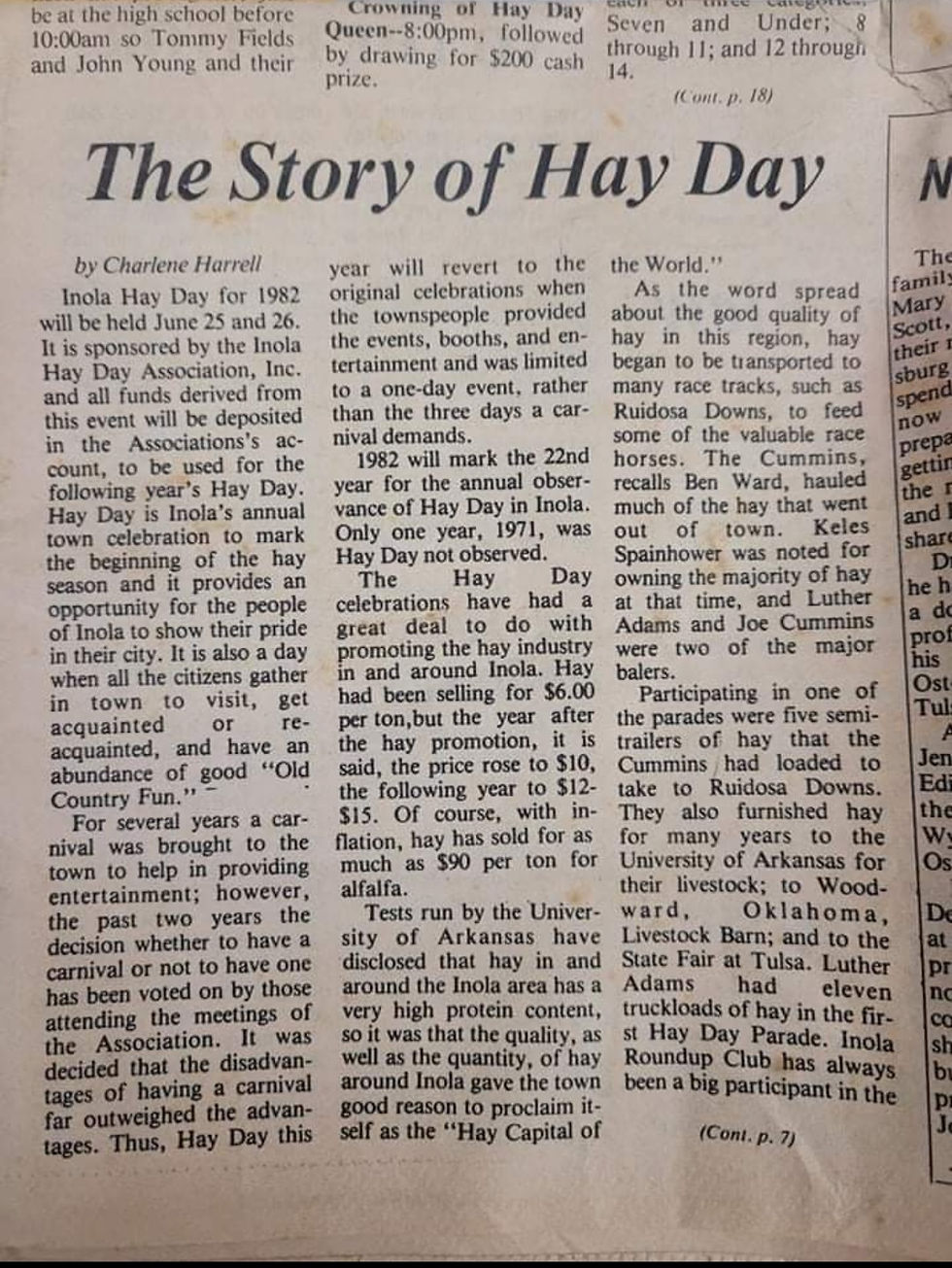
Inola Hay Day for 1982 will be held June 25 and 26. It is sponsored by the Inola Hay Day Association, Inc. and all funds derviced from this event will be deposited into the Association's account, to be used for the following year's Hay Day. Hay Day is Inola's annual town celebration to mark the beginning of the hay season and it provides an opportunity for the people of Inola to show their pride in their city. It is also a day when all the citizens gather in town to visit, get acquainted or reacquainted, and have an abundance of good "Old Country Fun."
For several years a carnival was brought to the town to help in providing entertainment; however, the past two years the decision whether to have a carnival or not to have one has been voted on by those attending the meetings of the Association. It was decided that the disadvantages of having a carnival far outweighed the advantages. Thus, Hay Day this year will revert to the original celebrations when the townspeople provided the events, booths, and entertainment and was limited to a one-day event, rather than the three days a carnival demands.
1982 will mark the 22nd year for the annual observance of Hay Day in Inola. Only one year, 1971, was Hay Day not observed.
The Hay Day celebrations have had a great deal to do with promoting the hay industry in and around Inola. Hay had been selling for $6.00 per ton, but the year after the hay promotion, it is said, the price rose to $10, the following year to $12-$15. Of course, with inflation, hay has sold for as much as $90 per ton for alfalfa.
Tests run by the University of Arkansas have disclosed that hay in and around the Inola area has a very high protein content, so it was that the quality, as well as the quantity, of hay around Inola gave the town good reason to proclaim itself as the "Hay Capital of the World."
As the word spread about the good quality of hay in this region, hay began to be transported to many race tracks, such as Ruidosa Downs, to feed some of the valuable race horses. The Cummins, recalls Ben ward, hauled much of the hay that went out of town. Keles Spainhower was noted for owning the majority of hay at that time, and Luther Adams and Joe Cummins were two of the major balers.
Participating in one of the parades were five semi-trailers of hay that the Cummins had loaded to take to Ruidosa Downs. They also furnished hay for many years to the University of Arkansas for their livestock; to Woodward, Oklahoma, Livestock Barn; and to the State Fair at Tulsa. Luther Adams had eleven truckloads of hay in the first Hay Day Parade. Inola Roundup Club has always been a big participant in the parades.
Cliff Adams, a lifelong resident of Inola, is responsible for giving the name of "Hay Day" to this once-a-year event. Ralph Sherrard, who owned a barber shop here and who is now deceased, was actually the promoter of Hay Day. Cliff reports thy had the assistance of many of the merchants in town, as well as the faith of many citizens of the community, in promoting this occasion.
Pledges from many merchants were made to finance the first Hay Day in case it didn't pay it's own way --- but, fortunately, a beautiful, sunshiny day was on the agenda and the whole community turned out to support their efforts.
A partial listing of the merchants at that time includes Bill NOrth's Grocery, Ben Ward's Inola Real Estate, Bynum's Sundry, Thompson's Grocery, Walter Schierloh's Inola Hardward, Carl and DickLadwig's Garage, Turn Green and Dal Ludlow's Garage, George Birkle's Machine Shop, Ezra Lawson's Real Estate, Al Pettigrove's Elevator, Gladys Maner's Cafe, Ralph Sherrard's Barber Shop, Otis, A.K., and Raymond Brunson builders, and O.W. Dyer, builder.
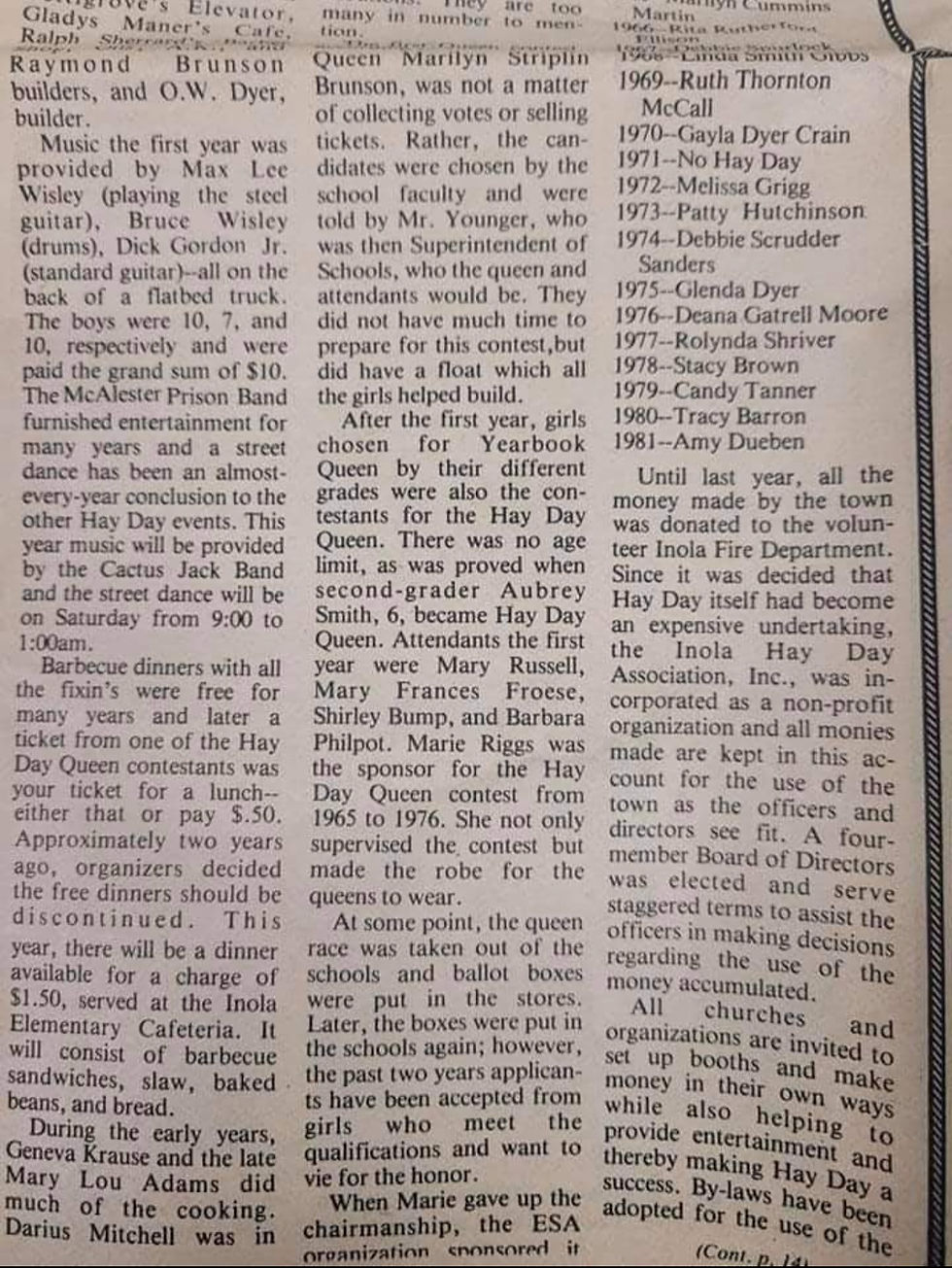
Music for the first year was provided by Max Lee Wisley (playing the steel guitar), Bruce Wisley (drums), Dick Gordon Jr. (standard guitar)--all on the back of a flatbed truck. The boys were 10, 7, and 10, respectively and were paid the grand sum of $10. The McAlester Prison Band furnished entertainment for many years and a street dance has been an almost-every-year conclusion to the other Hay Day events. This year music will be provided by the Cactus Jack band and the street dance will be on Saturday from 9:00 to 1:00am.
Barbecue dinners with all the fixin's were free for many years and later a ticket from one of the Hay Day Queen contestants was your ticket for a lunch--either that or pay $0.50. Approximately two years ago, organizers decided the free dinners should be discontinued. This year, there will be a dinner available for a charge of $1.50, served at the Inola Elementary Cafeteria. It will consist of barbecue sandwiches, slaw, baked beans, and bread.
During the early years, Geneva Krause and the late Mary Lou Adams did much of the cooking. Darius Mitchell was in charge of barbecuing the beef, which was reported to be as much as seven quarters of beef. The beef was always donated--some of the donations made by Diem's Ranch, McFarlin Ranch, as well as other business, groups, and individuals donating beef or money to purchase beef. Spec Forbus was instrumental in providing produce for much of the slaw. Quantities of produce used included 200 pounds of cabbage and 50 pounds of onions. Twelve cases of pork and beans were necessary for the dinner and Rainbow Bread was remembered as furnishing the bread, while Guy's provided them with potato chips.
Clem McSpadden and Bill Briscoe were invited guests one year. They were both politicians and running for offices and found that coming back in the kitchen and dipping beans put them in close contact with many of the members of the community. Many of the citizens recall a lot of hard work put in on the dinners and preparation for Hay Day and will be remembered for their contributions. They are too many in number to mention.
The first Queen contest, according to 1960 Hay Day Queen Marilyn Striplin Brunson, was not a matter of collecting votes or selling tickets. Rather, the candidates were chosen by the school faculty and were told by Mr. Younger, who was then Superintendent of Schools, who the queen and attendants would be. They did not have much time to prepare for this contest, but did have a float which all the girls helped build.
After the first year, girls chosen for Yearbook Queen by their different grades were also the contestants for the Hay Day Queen. There was no age limit, as was proved when second-grader Aubrey Smith, 6, became Hay Day Queen. Attendants the first year were Mary Russell, Mary Frances Froese, Shirley Bump, and Barbara Philpot. Marie Riggs was the sponsor for the Hay Day Queen contest from 1965 to 1976. She not only supervised the contest but made the robe for the queens to wear.
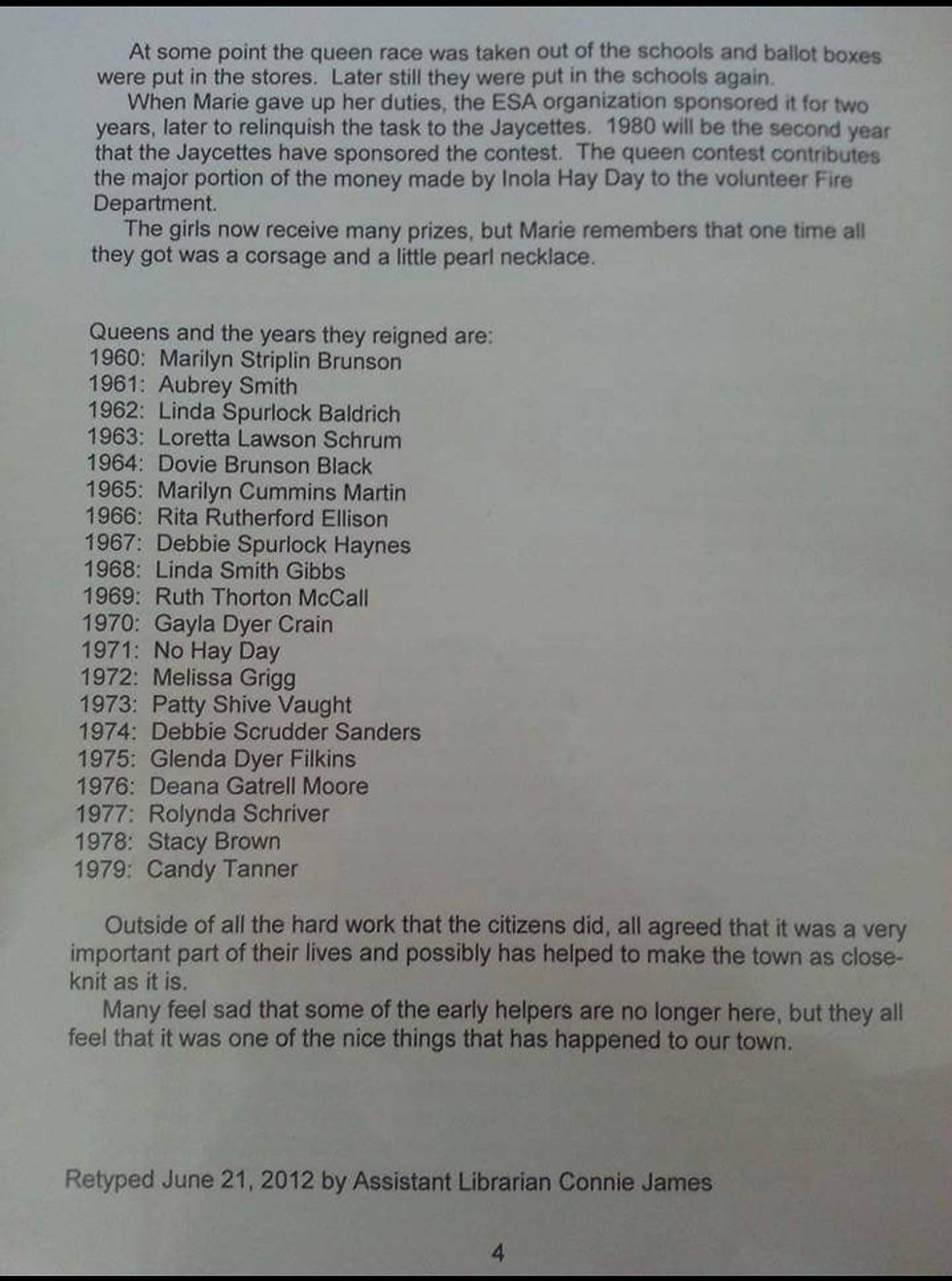
At some point, the queen race was taken out of the schools and ballot boxes were put in the stores. Later, boxes were put in the schools again; however, the past two years applicants have been accepted from girls who meet the qualifications and want to vie for the honor.
When Marie gave up the chairmanship, the ESA organization sponsored it for two years the Jaycettes for two years, and in 1981 Marie Riggs again took over the responsibility of sponsoring the contest. This year's sponsor is Vicki Ferrell.
All records were broken in Hay Day ticket selling in 1981 when a total of $6,548.50 was raised by the seven contestants selling $0.25 chances on a $200 prize. The winner sold $2,275.00 while the runner-up also broke previous records at $1,621.00.
Three contestants have entered this year and are again selling $0.25 chances on a $200 prize. One of the major prizes for the winner will be a $350 scholarship to Claremore College. All the girls will win a trip to Worlds of Fun, as well as other prizes. A list of the queens and the years they reigned follows:
1960 -- Marilyn Striplin Brunson
1961 -- Aubrey Smith
1962 -- Linda Spurlock Baldridge
1963 -- Loretta Lawson Shrum
1964 -- Dovey Brunson Black
1965 -- Marilyn Cummins Martin
1966 -- Rita Rutherford Ellison
1967 -- Debbie Spurlock Haynes
1968 -- Linda Smith Gibbs
1969 -- Ruth Thornton
1970 -- Gayla Dyer Crain
1971 -- No Hay Day
1972 -- Melissa Grigg
1973 -- Patty Hutchinson
1974 -- Debbie Scrudder Sanders
1975 -- Glenda Dyer
1976 -- Deana Gatrell Moore
1977 -- Rolynda Shriver
1978 -- Stacy Brown
1979 -- Candy Tanner
1980 -- Tracy Barron
1981 -- Amy Dueben
Until last year, all the money made in the town was donated to the volunteer Inola Fire Department. Since it was decided that Hay Day itself had become an expensive undertaking, the Inola Hay Day Association, Inc., was incorporated as a non-profit organization and all monies made are kept in this account for the use of the town and officers and directors to see fit. A four-member Board of Directors was elected and serve staggered terms to assist the officers in making decisions regardling the use of the money accumulated.
All churches and organizations are invited to set up booths and make money in their own ways while also helping to provide entertainment and thereby making Hay Day a success. By-laws have been adopted for the use of the...(end of article in photo)


History of Rogers County by Bob Burke and Eric Dabney
To the outside world Inola is known as the "Hay Capital of the World." For those who take the time to visit and get to know the locals, they can leave feeling like part of the family. Inola is located at the souther tip fo Rogers County., thirty minutes from Tulsa and twenty minutes from the county seat of Claremore. Inola is the ideal location for easy access to the Will Rogers Turnpike: Route 69 will get you to Kansas or into Dallas, Texas. Hop back onto 412 and Arkansas is only forty-five minutes away.
Inola sits on what was Creek Indian land, near the border between Creek and Cherokee nations. It was named by William P. Ross, twice chief of the Cherokee Nation, after a half-breed named E-No-Lah, or Black Fox. Inola is situated in the perfect geographic location for growth and for years town leaders have believed that Inola's time is just on the horizon because of its easy access to roads, railroads, and the river.
Inola is built around the families that have been part of Inola for generations. many of the same families are still part of Inola to this day. Inola's small town cafes are known for their home-style cooking and have a reputation for being some of the best in Oklahoma. If you visit from out of town, do not be surprised if a local sits down at your table if you have an empty chair available.
The Inola Volunteer Fire Department is one of the best volunteer fire departments in Oklahoma. They are the only certified scuba rescue team in Rogers County and the surrounding areas. And they are also 100 percent first responder certified.
Inola Hay Day is a historical event in Inola. The festival is held the last weekend in June as was traditional when the celebration first started to celebrate the first good cut of the haying season. Now Hay Day is a time to come into town from Thursday to Saturday Night and enjoy the carnival, the beauty pageant, the car show and the live entertainement and street dance. Other fun activities include the frog jump, the turtle races, the horseshoe tournament, the hay toss and cow patty bingo.
The Inola Chamber of Commerce strives to encourage, inform and support the membership of current and future economic development and munisicap issues Inola formed REDI (rural economic development of Inola) in 2008 which is an authority that is a branch of the city. The chamber and REDI will work hand in hand for the economic development of Inola. The chamber lunch is the first Thursday of the month at noon at the Inola United Methodist Church.
The Inola senior citizens center is open Monday to Friday from 12pm to 5pm to accomodate any seniors who want to use the facility to visit, play cards, etc. Lunch is served on Tuesdays and Thursdays at noon for $3 per meal and dues for members are $3 per month.
The Inola Public Library is open five days a week and offers public access computers, books on tape, videos, and a wide range of books. A new service at the library is called the Inter Library Loan. The library can get any book within a few days of a person's request. The library hours are Monday, Wednesday, and Friday from 10 to 4:30 and Tuesdday and Thursday from Noon to 7.
Inola has been considered the "Hay Capital of the World" for thirty-five years because of the high quality Bluestem Prairie hay grown in the many hay fields here.
People who want to do business in a community where everybody knows your name, take a longer look at Inola. Inola is a close-knit community taht is known for taking care of its own. A quick drive through town will result in many friendly waves.

